01 · Identity
Content-addressed storage
Names immutable objects from their canonical bytes, verifies reads, and reuses exact duplicates across files, layer stacks, and agents.
Press ← or → to navigate between chapters
Press S or / to search in the book
Press ? to show this help
Press Esc to hide this help

Ephemeral Workspaces. Durable Shared History.
LayerFS gives every agent an isolated, disposable filesystem fork without copying the shared base. Useful states become durable, deduplicated checkpoints with workspace-scoped tool history—ready to branch, rewind, or reuse across parallel development, environment experiments, and MCTS-style rollouts.
01 · LayerStack storage model
CAS, CDC, and COW make LayerStack history storage-efficient by reusing unchanged objects, file regions, and filesystem structure.
01 · Identity
Names immutable objects from their canonical bytes, verifies reads, and reuses exact duplicates across files, layer stacks, and agents.
02 · Byte locality
Keeps chunk boundaries stable around localized edits, so changing a small region does not require storing an entirely new large file.
03 · Structural locality
Publishes a change in a new layer by rebuilding only the changed file and directory path while preserving every unchanged subtree from its parent.
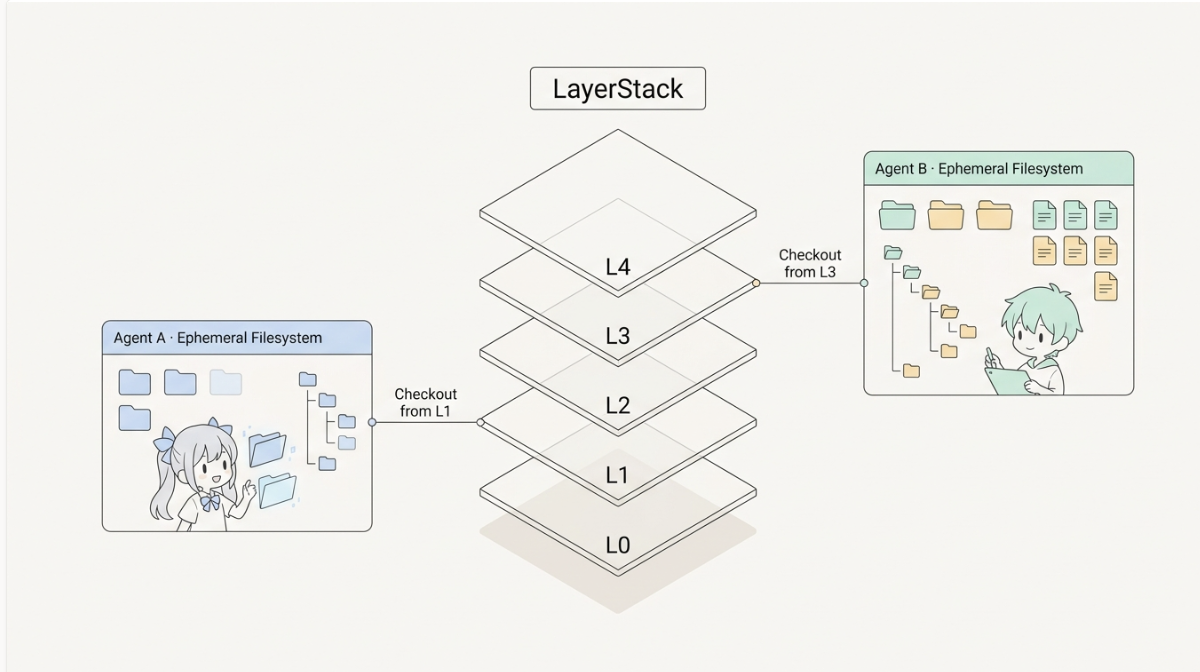
A LayerStack records complete filesystem checkpoints. Agent A can start from L1 while Agent B independently starts from L3. Each gets a private place to work while the selected history remains shared.
02 · System boundaries
The storage engine is implemented today. The SDK and filesystem projection are the planned interfaces around it.
Owns identities, canonical objects, CDC, file manifests, structural COW, packs, immutable CAS admission, lifecycle coordination, and verified reads.
Will expose stable filesystem, workspace, layer-stack, and publication operations without leaking private CAS handles or storage formats.
Will expose a workspace to an agent and capture bounded filesystem effects. It delegates identity, CDC, COW, and admission to storage.
03 · Reading path
The book follows the same dependency order as the storage model: establish immutable content identity, localize file edits, rebuild only changed filesystem paths, and then organize those states into agent histories.
04 · Ecosystem
LayerFS supplies storage mechanics. The surrounding projects own execution environments and version-control workflows.
 AgentsGit
Version control for agent work in motion: checkpoint, branch, compare, recover, and promote.
↗
AgentsGit
Version control for agent work in motion: checkpoint, branch, compare, recover, and promote.
↗
 Ephemeral Sandbox
Isolated execution environments for parallel agents.
Ephemeral Sandbox
Isolated execution environments for parallel agents.
Powered by Ephemeral AI Lab